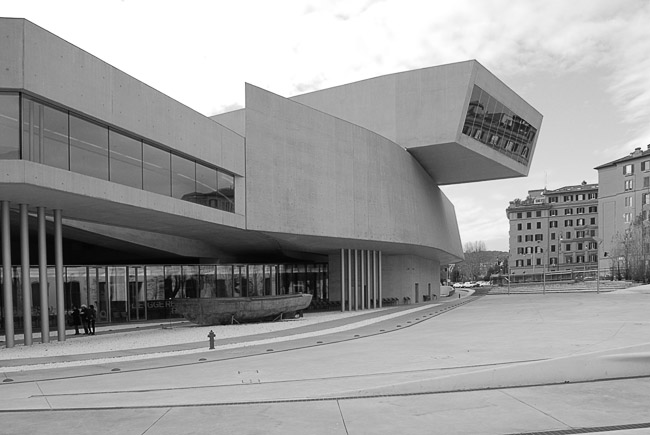
How does an art institution come to be? Historically, private collections were made public – the Soane Museum for example, or the Louvre, where the king’s private collection was opened to the public after the revolution. In most cases, though, a building was constructed for or around a collection in one way or another. MAXXI is a different beast altogether, a museum with a building that will collect the art as it goes along.

The art museum as an institution and building has gone far from the palatial, awe-inspiring institutions of the 19th century, where the architecture gave the institution gravitas. The 20th century art museum was a different affair, less monumental but much more radical; take the Guggenheim New York, for example. The 1970’s witnessed yet another incarnation of the art museum, exemplified by the Centre Pompidou in Paris; here, the art museum took a step out into the city and became instrumental in redefining local neighbourhoods. A transparent wall dissolved the border between the city and the museum. It was only a matter of time until the architecture began aspiring to being a work of art itself. Arguably, the era of iconic architecture was ushered in by Frank Gehry’s Guggenheim Bilbao. The museum building became as important as the collection it housed, if not more. Zaha Hadid’s MAXXI in Rome is in many ways the logical continuation of this development: a museum without a collection, a museum that is solely architecture. This evolutionary process gives rise to the question: what in fact constitutes an art museum – its collection or its building?

MAXXI is dedicated to 21st century art, and its collection is to be assembled over time.  It is a museum of future art and architecture. At this moment in time, it stands almost entirely empty in wait of the future, which will adorn its halls with a collection. When I visited earlier this year, the only work on display was a beautiful and comprehensive Luigi Nervi exhibition. The Italian Nervi was the mastermind behind a great deal of grand 20th century architecture and almost certainly a source of inspiration for MAXXI’s design. At the time of my visit, three of the five gallery suites were closed and all of the visitors were congregated in the spectacular entrance hall, and I had the outstanding Nervi exhibition all to myself. I’ll come back to Nervi in a moment.

MAXXI is in many ways a curious project. Perhaps most peculiar of all is that a museum of the future has been constructed in Rome, a city with perhaps more history than any other European city and which is incidentally barely able to handle the upkeep of its countless historical treasures. A few hundred metres away from the Nervi exhibition stands one of Nervi’s original buildings in a state of disrepair. Perhaps it is this very burden of the past that has inspired the museum in the first place; Rome may well need to forget the past once in a while and focus on the future.

The MAXXI is located in northern Rome, in the Flaminio district. Large-scale installations such as Flaminio Stadium and military compounds intermingle with residential districts, and the variation in scales has a strange effect on the urban life; some areas feel almost deserted, whilst others retain the vitality of most of the grand city. From the main approach at Via Flaminia, the museum is all but invisible, its presence signalled by great flags that lead the visitor to the museum. It is a strangely humble approach. Only when one is more or less in front of the museum compound does it suddenly rise up out of the urban fabric; a moving, twisting thing.

One of the museum’s objectives has always been to infuse this area of Rome with life and vitality, presumably in the same way the Centre Pompidou effected Beaubourg. The Centre George Pompidou reaches out into the city, its transparent walls animating the square around it, and the building becomes a part of the urban fabric. The MAXXI, on the other hand, is a compound; its urbanity is inside a clearly defined border, with heavy gates designed with patterns similar to the shape of the museum. The gates are open during opening hours, but the museum has neither desire nor ambition to melt into the surrounding city.

The compound itself is made up of quite a few renovated barracks buildings and Zaha Hadid’s new museum. Between them is a landscape/urban space, also designed by Hadid, where lines and materials swoop through and “energise” the space. This space has the potential to become an interesting space in daytime, although the museum’s enormous gates keep it quite separated from the surrounding city.

The MAXXI was designed by Zaha Hadid Architects in the late 1990’s, and like any humongous, technologically advanced building, it took a long time to build. This means that the MAXXI is a product of Zaha Hadid’s office from the days before NURBS modelling software changed the output forever. In terms of ZHA chronology, the building looks as if it should have been finished quite a few years ago. On the other hand, the energy of the architect herself is more present and palpable than in her later work.

It is never very much fun to analyse a Zaha Hadid building from a functional perspective; it almost inevitably leads to a certain smug satisfaction in the observation of mistakes in execution and design. The same goes for materiality and detailing, which have never been the office’s strong side – and let’s face it –are simply not the reason why people choose ZHA. Zaha Hadid is employed is to deliver grand architecture, architecture with spectacular spaces, energy and power, architecture that defies gravity.

In that respect, MAXXI is a success. Since its opening last year, critics have used all the bombastic words in their vocabulary to describe and praise it. It has been compared to baroque masters like Borromini and most other great structures of the eternal city. ZHA aims to merge landscape and architecture, which is a very interesting ambition indeed. In MAXXI, it is rather successful. The great entrance hall which connects all of the spaces feels more like a canyon or a cavern than a space inside a building. It is a fluid space that meanders, turns and twists and captivates. The colossal entrance hall is a marvel to the eye, its grandeur only slightly diminished by the hollow ‘clonk, clonk’ as one ascends or descends the metal staircases. The great hall has justly been referred to as Piranesian, and one can readily see why. The meandering staircases interweave high above your head, disappear and reappear in a very complex space. The sheer energy of Zaha Hadid is very present, and it is breathtaking as a space. The architecture must however be measured against its ambitions.

A Piranesian system is by definition introverted, forever losing itself in itself, and it is very difficult to imagine it relating to a world outside. MAXXI is attempting to be both extroverted and introverted simultaneously, and should probably be credited for succeeding so well in the circumstances. In order to complete the Piranesian illusion, a looping system is essential. It requires continuity. In order to simulate infinity, all spaces must lead back to the starting point in one way or another. The MAXXI, however, has its fair share of cul-de-sacs, which are fatal to the illusion of infinity. It works some of the time, making those galleries which lead you into a blank wall or a window out onto the rather dull surrounding neighbourhood all the more disappointing.

The ambition level of the project is extremely high, and the museum contains a number of fantastic spaces within its gargantuan shell, the most magnificent of which is the giant hall. Spatially, it almost succeeds in creating the illusion of a Piranesian warped space it intends to, but where the building attempts contact with the city outside and in the cul-de-sacs, the illusion is brought to its knees. Ironically, it is when Zaha Hadid acknowledges the context that her architecture suffers, at least in this case. Still, the ambition and energy put into the project have to be applauded – it is a spectacular achievement to construct this building anywhere, perhaps even more so in Rome, a city notoriously difficult to build in.

The MAXXI was built as a kind of speculative art museum, almost entirely without a brief; the program will supposedly emerge over the coming century. It is an art museum built backwards, where the building is constructed first and subsequently over time filled with art as the century goes on. It is a fascinating experiment in how to construct a museum from zero. This concept as well as the museum building itself are very much products of their time; the age of iconic architecture, where form and architectural form triumph over content and substance, where the ‘container’, so to speak, is more important than its content.

Is MAXXI the ultimate incarnation of the iconic building – architecture entirely without a programme? This remains to be seen. Should it manage over time to fill its vast, curvy, cavernous shoes with an interesting programme and collection, it may well be successful; if not, it will become a gigantic folly, a testimony to the credit-happy-go-lucky days of the 2000’s.

image copyright Rossanna Bartoli

The relationship between architecture and property taxation is a territory that is largely unexplored as far as I know. A few attempts are made to create tax incentives, primarily to create walkable neighbourhoods or to promote renewable energy and energy efficiency. There is, however, an entirely different side of architecture influenced by taxation to explore: tax-optimised architecture, or the architecture of tax evasion. Tax-optimised architecture is a typology of architecture designed to exploit loopholes in taxation laws, preferably to avoid taxation entirely, or at least to minimise it. This means that the tax laws, or rather the areas  not covered by them, become the primary factor influencing the design of the architecture. Architecture as an e contrario interpretation of the tax laws in short.

In Sweden, the ‘Friggebod’ has been the primary expression of tax-optimised architecture. In 1979, the then-Minister of Housing Birgit Friggebo created a law allowing homeowners to build small sheds on their properties without construction permits. The sheds, maximum two per property, were not to exceed ten square metres in area (this was later raised to fifteen) or three metres in height, and were to be placed a certain distance from the edge of the property. Apart from these stipulations, there are practically no limitations on their design. Since the introduction of Friggebodar, Sweden has seen an explosion of construction of these sheds: twenty years later, there were already about a quarter of a million spread across the country; the exact number is unclear. Pretty soon, Swedes started to elaborate on the Friggebodar, maximising the limited area with temporary extensions and foldable walls to extend the sheds. One of the more radical examples was designed by architect Sören Stenqvist and exhibited at the H99 housing exhibition. Unfortunately, I’ve been unable to find any images of it. As far as I remember, it was a structure whose size could increase to double the regulation size, and then be reduced to comply with the legal ten square metres should the tax department pay a visit. I sometimes suspect that the real motivation for these elaborations is as much spite for the tax department as it is a real need for extra space.

The history of tax-optimised architecture is presumably as old as property taxation. History contains many legendary examples. Perhaps obviously, there is no recorded history of tax-optimisation of architecture, and most examples presented here are – from a scientific perspective – dubious at best. The most famous historic example in the Anglo-Saxon world is the window-tax imposed in England in the 17th and 18th centuries, which (legend would have it) gave rise to the expression ‘daylight robbery’. At the time of the window-tax’s introduction, personal integrity was a matter taken very seriously, which prevented the state from basing its property tax on any of the more common parameters such as area or value of the building, as disclosure of such information would have necessitated an uncivil intrusion into the private life of the property owner. Thus, tax had to be based on elements discernible from the outside and somehow related to the value and area of the property; hence, the number of windows. As a result, three different tax levels were imposed on properties: those with less than ten, those with between ten and twenty, and those with more than twenty windows. Naturally, owners of buildings with eleven or twelve windows were disadvantaged and often bricked up a window or two in order to lower their taxes. New constructions were equipped with a number of windows in the upper end of the different brackets, and as a result, properties were often constructed with fewer windows than they normally would have been equipped with.

Another historical example is Amsterdam, a city with deep narrow houses with the gable facing the street. Allegedly, this was the result of a property taxation based on street frontage imposed during the critical centuries of the city’s construction. The houses were often so narrow that furniture could not be brought up the stairs, and instead had to be hoisted up from the street to the upper levels. Each house was therefore equipped with a small crane. I’m sure there were other reasons as well, but to an extent, what we consider Amsterdam’s vernacular architecture is an example of tax optimisation: a thrifty population elaborating on the opportunities to minimise their taxes.

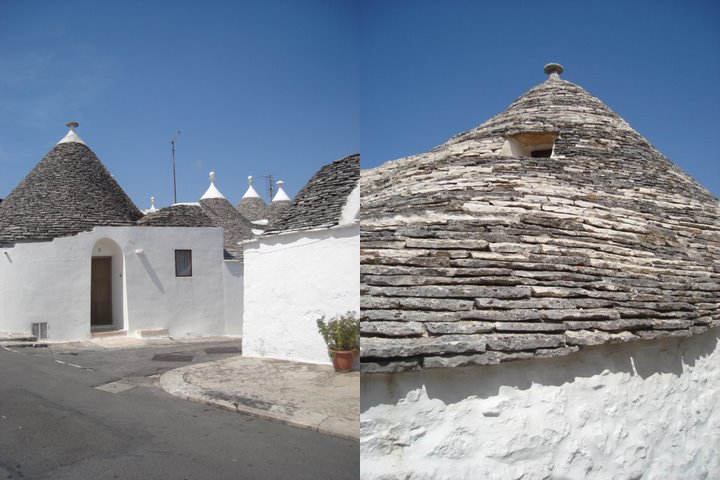
The most radical example I have encountered are the trulli of Apulia, southern Italy. According to Bernard Rudofsky’s ‘Architecture without Architects, ’These were built of “annual layers of stone that terminate in a false conic cupola crowned by a keystone”. The origins of this type of dwelling are disputed. Popular belief suggests that this peculiar type of construction was an innovative method of tax evasion. As they were constructed without mortar, they could be pulled down when word spread that tax inspectors were in the area, and then reconstructed upon their departure. The town could thus double its size, while its taxes remained at the level of a village. Again, this is a theory with little scientific and great popular support. In reality, the trulli’s form is reminiscent of very early human settlements, and the constructions most likely predate property taxation.

Whether the examples above are true or just folklore, it is both exhilarating and somewhat unnerving to imagine vernacular architecture as not only the product of climate, available construction materials and local cultural traditions, but also the product of a profound unwillingness to pay taxes which is quite apparently engrained deeply in the human consciousness. In a sense, the extensions and elaborations of the small Friggebodar is part of a battle between people and tax inspectors that has raged since the dawn of taxation. Makes you wonder if tax inspectors really are the root of all evil and the creators of this type of architecture are righteous, justly standing up for their rights, or if people have just always been stingy.

It would be interesting to further study the effect of taxation on the emerging vernacular of the Friggebod and other contemporary examples. I suspect there is a great market niche here. I’m contemplating setting up an Office of Tax- Optimised Architecture, based in the Cayman Islands, developing new vernacular architecture around the world, generated by local taxation laws. Then again, I think there are a number of firms doing exactly this already- and with less conspicuous names. Venturi and Scott Brown focused on semiotics in their analysis of the Strip in Las Vegas, but it could be argued that the architects of tax evasion, along with their corresponding adversaries in the tax departments, are the authors of a parallel strain of vernacular architecture, running through history, individually tailored to the local conditions across the globe but as of yet uninvestigated.

image from www.the-berg.de

The following is an excerpt from the book Berlin-matter of memory

Once in a while, the vision for a structure becomes so engrained in the collective mind that its virtual existence can almost be mistaken for concrete. This is the case of the Tempelhof Berg; the image has become a virtual relic, even available as postcards and prints.

During the debate on the future of Tempelhof, an illustration where Tempelhof has been transformed into a 1000 m tall mountain suddenly started appearing everywhere. The creation of architect Jakob Tigges, the mountain was entered into – and quickly eliminated from – an idea competition as a politically critical, tongue-in-cheek proposal. Nonetheless, the strong illustrations found their way into newspapers, into the minds of Berliners, and on to the postcard pictured below. It can be found in the strangest of places: I recently saw it hanging framed in a bar among photos of historic images of the city. The idea simply resonated very well with Berliners, and it was viewed by many as an ideal solution for the old disused airport.

The only problem is its construction; the newspaper Tagesspiegel calculated that in order to construct the mountain, 47 000 trucks would need to deliver 20 tonnes of construction debris daily for a period of over five years in order to build the enormous mass. And then there’s the question of whether the notoriously unstable ground could take such an enormous weight. Even so, the traffic of trucks would clog the Berlin traffic apparatus for years, release untold amounts of carbon dioxide emissions into the atmosphere and create endless problems for the city and the planet. Not to mention the costs for a city so famous for its empty coffers that for a long while the city slogan, coined by former mayor Klaus Wowereit was: “arm aber sexy”, poor but sexy. The mountain is a pipe dream, and everybody is well aware of this.

Relics often have a place in the collective mind even if they no longer exist; Crystal Palace is one such relic. Planned, future relics can occupy a similar position in people’s minds. The Tempelhof Mountain, however, is a strictly virtual relic with no relationship to physical reality. It is the virtual world blurring the borders with the physical world.

The virtual relic is a product of digital culture. Photomontages and other credible visual evidence can easily be manufactured. Computers and digital culture also make it possible to disseminate convincing illustrations into the collective mind. By presenting that illustration in various ways, it starts to inhabit the mind, much in the same way effective advertisement places products in our minds. The digital culture allows the collective mind to separate from the physical world and enter the virtual world. The virtual world of our collective mind then interlaces with the physical world, creating images in our minds of things that never were, producing entirely virtual relics.

The connection between the virtual and the collective mind allows the virtual to seep into reality in unexpected ways. It creates a situation where the virtual and the physical approach each other and merge. When the virtual leaks into the physical world, we are seeing something entirely new. In a way, it is as if the collective mind of Berlin created its avatar, the digital alter ego that is all Berlin wishes it was, and that avatar then started showing up on postcards and walls.

The collective mind has previously produced hyper-realities, which have then been realized into physical forms. Hyper-reality is the authentic fake, as Umberto Eco put it – the collective image of times past, for instance. Often this image bears little resemblance to what’s beyond the surface.

In a sense, the postcards are from a new Berlin, where physical reality and the virtual reality are interlaced. It is not only the physical reality that merges into the virtual reality, but also the virtual invading the physical space.

The future of Tempelhof is still open, but it should be interesting to see for how long the virtual history will run parallel to the actual history, at which point these again will be detached from each other and the mountain reduced to the relics of the dream in forgotten images and dead pixels.

The Vietnamese constitute a large minority group in Berlin, presumably the largest after the Turkish. This year marks twenty years since the reunification of Germany, but it also marks twenty years since the another reunification, the almost forgotten and very strange reunification between the North and South Vietnamese in Berlin.

The Vietnam War between the US-backed South Vietnamese and the Soviet-backed North Vietnamese has left a curious relic in Berlin. The German Democratic Republic was by proxy a supporter of the North Vietnamese and accepted guest workers as well as students since the 1950’s. These were admitted on five year contracts, after which they were supposed to return to Vietnam. The Federal Republic of Germany on their part were by proxy supporters of the South Vietnamese, and in the wake of the fall of Saigon in the middle of the 1970’s accepted approximately 30 000 Vietnamese asylum seekers. Many of these were Chinese-Vietnamese so-called boatpeople, who would have had a very rough time in the reunited Vietnam as the Vietnamese are very suspicious of their Chinese neighbour.

The reunification of Germany meant a reunification of their respective Vietnamese communities, halfway across the world from their home country. The South Vietnamese had in the meantime integrated rather well in the Federal Republic, while their North Vietnamese counterparts had been isolated from the East German society and had hardly any knowledge of the language. It was a reluctant reunification with a lot of suspicion on both sides. The only thing that united them was an unwillingness to return to Vietnam.

After reunification, the North Vietnamese faced a tough situation. Their jobs within the East German industry were gone, and they had little means of supporting themselves. Some turned to crime, and Vietnamese gangs started to generate incomes by any means available. The primary racket was, and still is, selling smuggled cigarettes. They are still visible on street corners in many parts of Berlin despite harassment from the Police.

Reunited Germany had little sympathy for the Vietnamese, and offered them plane tickets back to Vietnam, and substantial grants for the Vietnamese government to accept their Diaspora’s return. In the end however, few went back and many became self-employed as means of support were mandatory in order to receive residency permits. This has created a great abundance of flower shops and small grocery shops run by the Vietnamese.

It has also helped to create the Dong Xuan Center in Lichtenberg – a run-down industrial area in East Berlin. The name is taken from a famous marketplace in Hanoi, but Berlin’s Dong Xuan Center is an Asian marketplace in a German setting. It consists of four huge structures, each with a central corridor lined with small shops selling any- and everything remotely Asian. It is like a small Hong Kong in the unlikely setting of a derelict industrial estate. Although it is primarily Vietnamese, the place is a conglomeration of traders and importers from across Asia. It looks exactly as you would imagine a weird and wonderful combination of German order and South East Asian vibrant mercantilism, if you can. The image above does absolutely no justice to the place as it was taken shortly before closing time.

It is not a place without controversy, and arson has been known to be used on occasion as a way to stifle competition in the fierce economical climate. A number of gang related incidents have furthermore caused the Berlin Police Department to set up a taskforce targeting organised Vietnamese crime syndicates.

The Dong Xuan Center is as close to  Little Saigon as it gets in Berlin. It is, in a sense, the centre of the Vietnamese community in Berlin; notice boards with classified ads and personals fill the walls inside the market. Although the Vietnamese community is one of the largest minority groups in Berlin, they are mostly invisible apart from the cigarette vendors and the city’s many Vietnamese restaurants. It is here, in an abandoned industrial estate that you find the centre of a forgotten minority group. And the centre of a forgotten parallel reunification. The Dong Xuan Center is a parallel little universe, far removed from the German community of which it is technically a part, a forgotten history that has created this very dynamic relic on an otherwise almost abandoned edge of Berlin.

Today, it is 21 years since the Berlin Wall came down. Here is another book excerpt from the book Berlin- matter of memory on the Wall and the voids that replaced it. A draft for this text was previously published on this blog about a year ago.

It is impossible to write about Berlin without including the former Berlin Wall. The Wall that separated the East from the West for twenty-eight years, from 1961-1989, officially ceased to exist over twenty years ago, but it still plays a central role in the city. When the Wall came down, the general opinion was that it should be excised from Berlin, from history and from the minds of the city’s inhabitants. The question of preservation was secondary to the desire for reunification, and voices asking the city to preserve stretches were raised only very late in the euphoric beginning of the 1990’s.

As it has turned out, the physical wall has become a ghost. A conscious policy to rebuild Berlin from Potsdamer Platz to Bernauer Strasse and the wish to conceal the city’s unsightly scars have led to the removal most of the actual Wall. As the Wall was superimposed on an already existing city – which has since been reconstructed – it can be difficult to trace the wall on a map today, while in the actual landscape, especially some distance away from the most central parts, many signs of the iron curtain’s physical manifestation can still be seen.

Many have written about the Wall, what it meant to Berlin as a monument and what it has continued to symbolise for Berliners. Since most of these are written by competent historians (see for example Brian Ladd’s “The Ghosts of Berlin”), I will keep to aspects concerning myself as an architect. The first of these is the significance of the physical void left behind by the Berlin Wall.

The voids of the former “death strip” have done more for the integration of the reunited city than any of the grand projects such as Potsdamer Platz or Spreebogen or the like. Today, the voids are what characterise Berlin and constitute the one of the city’s prime assets. One could even say that the voids define Berlin culturally. Architect Rem Koolhaas was fascinated by the void when the Wall was still standing, and wrote the now-famous words ‘where nothing exists, everything is possible’.

It has now been twenty years since the Berlin Wall fell, the iron curtain was lifted and Berlin became one city again. During the first few years after the Wall came down, investments in the reunited city were made on a scale that rarely has been rivalled in Europe. At some point however, Berlin ran out of money and the city has been struggling economically since. The construction has continued, albeit on a smaller scale. Many of the new projects are constructed on land where the Wall used to run.

To some, the void left after the Wall is a scar which can’t be concealed rapidly enough; as long as the scar is visible, the division of Germany and the inequalities resulting from the unification remain contemporary. These memories can’t be written into the history books as past until the void has been filled. As long as the wound is open, the past will continue to leak into the present. Monuments make history, while scars keep the past current.

Architect Daniel Libeskind saw the physical voids as mental voids in the collective mind, the marks of a society broken and a representation of the relationship between Germany and its Jews that was destroyed in the Holocaust. He maintained that the psychological voids would remain even if the physical voids were filled with new buildings.

The Wall was the millstone around Berlin’s neck, but through its demolition, this symbol of oppression became the stage for freedom. The cultural capital Berlin would be unthinkable without the voids; this is where nightclubs, art-installations, concerts and flea markets thrive(d) to make Berlin what it is today. These spaces can be used for anything or for nothing. Experimental culture can burgeon and evolve. For all intents and purposes, these ‘unprogrammed’ spaces are the cornerstones of cultural innovation in this city.

The voids give Berlin a unique spatial character and create unique opportunities in regard to public space. The voids are free spaces, to be used or inhabited in different ways as long as it is of a temporary nature. In and of themselves, the activities taking place in these spaces are monuments to freedom. The voids are a by-product of the Wall, perhaps the only positive one. If we decide that the voids of Berlin are spatial monuments, they are no longer functionless empty spaces. On the contrary: the voids become spaces worthy of preservation.

Another aspect of the Wall is the layer of activity and function it now creates on top of the reunited city. An almost invisible line crisscrossing through the city, the former path can be – and is – explored by tourists and Berliners alike, providing a view of the city from a new perspective. Travel along the Wall’s former path is best undertaken by bicycle and entails moving in an atypical pattern through the city, passing through neighbourhoods which would otherwise remain unseen.

Is the Wall today an relic or a monument? The voids are definitely relics, while the preserved stretches are monuments; they are authored in the sense that they are interpreted rather than objective. The museums and preservation zones are monuments, encoded with messages and interpretations. There are three separate permanent Wall exhibitions filling different functions in the city to date. The “Gedenkstätte Berliner Mauer” on Bernauer Strasse is concerned with the preservational aspect, meticulously tending a section of the former death strip and commemorating of its victims. Perhaps the most famous preservation zone is the “East Side Gallery”, a section of the Wall which was converted to a gallery shortly after the fall. Artists were invited to decorate a length of Wall in East Berlin which had previously (for obvious reasons) been free of graffiti. Although the section of Wall is more a gallery of street art than a memorial, the East Side Gallery tends to be the destination of choice for tourists, as the colourful murals correspond to their vision of how it ought to be. The privately-run Mauermuseum – Haus am Checkpoint Charlie (Checkpoint Charlie Museum) focuses on spectacular escapes and escape attempts during the years of the Wall. It also offers an opportunity for visitors to be photographed with border guards and have their passports stamped.

The rest of the Wall is a relic, albeit one whose effects on the demographics and the social composition of different areas is much more in your face than the disappearing physical traces. The integration of the reunited city is slow, much slower than anybody expected, and even twenty years after the fall, the demographic division remains.

Areas with high non-German populations are generally the areas that were just on the Western side of the Wall, dead ends during the divided years but today quite central areas – for example Wedding, Kreuzberg or Neukölln. Areas on the Eastern side are typically old and run-down, with a few exceptions. These areas were rapidly gentrified when the Wall fell and still host a large, floating, international population of artists, architects and other people without proper jobs.

To preserve the void as a common territory and acknowledge the unique spatial conditions with which Berlin’s turbulent history has provided the city would be a positive motion and create opportunities which will eventually help Berlin out of its slump, or slumber. Berlin will never be as picturesque as other German cities, but what it does have is a unique urban landscape of spatial opportunities unrivalled by any other European city.

I walked by this interesting and charming residential building in northern Berlin the other day. It turns out it was designed by Brandt und Simon Architekten, who incidentally also designed my local bar, Kohlenquelle which, to be perfectly honest, I up to now suspected had never been designed at all. The striking feature of the building however is the pixelated façades made up from tiles or shingles, allowing the building to merge with the surrounding garden, to dematerialise and disappear depending on how you observe it. It is in a sense a form of ‘stealth architecture’, the term is, if I remember this correctly, borrowed from Mike Davis’ ‘City of Quartz’ (a terrific portrait of Los Angeles and a great analysis of the militarisation of urban and architectural space for anyone who has yet to read it). Mike Davis uses the term to denote alleged (it is in their nature to be elusive) buildings in Venice Beach that are built for affluent clients yet designed to appear insignificant and shoddy from the street so as not to attract burglars. The building above is a different type of ‘stealth architecture’, where the stealth element is more a matter of style than of military tactic.

In the military sense of the word, man has constructed ‘stealth architecture’ since he started building. Shelter was always constructed so as not to attract attention, at least until city walls and other defensive structures replaced the need for concealment to an extent. In times of peril, many smaller mountain towns would have hidden refuges as a last resort of protection. All ages have produced stealth architecture in the military sense. Bunkers constitute the avant-garde of military stealth architecture. Recently however, the civilian application of stealth as style has evolved, from all corners of the world, for various motives, but with one common aim; to create architecture that pretends it does not exist.

One example of ‘stealth architecture’ is ‘Old House’ in Tyson Street, Melbourne, by Jackson Clements Burrows Architects. Commissioned by a client to build a modern building, restricted by the preservation zone the site was located in, the architects negotiated a compromise. They constructed a modern building, but the street façade was clad with a full-scale photography of the old building. The result was a trompe l’oeil, if one stands directly in front of the building; the new and the old merge and become indistinguishable. Its angles and perspective lines line up from that one point, in a way thus preserving the homogeneous character of the area.

The architects describe their project like this:

“The project attempts to elevate the difficulties of obtaining planning approvals in heritage areas into a sublime and ironic gesture which may generate debate about the problem itself. In this sense it is both a critique of the process and a surreal architectural solution which is evocative of the site’s memory and historical context.”

It is a compromise where the new building and the image of the old merge, forming a very strange unity of past and present. One could argue that the project enters into a dialogue with its context through its obvious falsification of the history, while the jabs at the planning department and the complications created by heritage laws are perhaps a commentary that can best be expressed in other ways than architecture.

Sweden has its fair share of stealth architecture. The gallery designed for Magasin 3 by Block Architecture is one interesting example. The façade of the building was clad by a ‘fence’ of reflective aluminium louvers that mirrored the surrounding landscape, allowing the building to appear or disappear as one looked at it. An almost shy structure that hides behind a mirror, a very non-intrusive form of architecture that dissolves into the park. Was this ever built by the way? I have never seen it, but then again, that was half the point, perhaps it is there and I have just never looked at it from the right angle while squinting. It is an interesting thought; perhaps it lies there, forgotten, only to be discovered accidentally one day by an old lady walking her dog.

Another interesting project is the Tree Hotel designed by Tham Videgård, a hotel room halfway up a tree in the gigantic forests of Northern Sweden. Its reflection distorts the view of the forest, creating a very light building completely subjecting to the natural landscape. The slight distortion of the forest and its perspective is the only sign of the building. I cannot help but think this will make a marvellous ruin if its location and existence is ever forgotten and then stumbled on by chance decades later.

A similar project, also subservient to the landscape is ‘Juniper House’, by Murman Arkitekter on the island of Gotland. A modern wooden building is here covered by a second skin, a camouflage suit, of full-scale photographs of the juniper landscape making up the context of the building. The resulting building becomes almost invisible and suddenly materialises and dematerialises depending on weather conditions and angle.

It is easy to dismiss ‘stealth architecture’ as a simple comment on the context, or in some cases even the planning department. In that sense, stealth architecture would simply be apost-modern, tongue-in-cheek, double-coded nod to the history of the site, and the context. In the worst case scenario, it is only a method for imposing new architecture in sensitive contexts disguised by a barely credible veneer of adaptation, a deliberate falsification undertaken to exploit new territory. On the other hand, the architects of these buildings have sought a way to construct a house, while at the same time offering the opportunity to view the scene without the building. In other words, ‘stealth’ is a method for having the cake and eating it too, a great feat to which mankind has always aspired but never quite pulled off. This type of architecture can also be interpreted as a more complex post-modern dialogue with context and history. Furthermore the architecture questions the nature, role and impact of architecture. Creating optical effects of dematerialisation is part of the interchange with context and beholder. It is however also a will to be invisible, an architecture of invisibility and transparency, ephemeral architecture in a sense, that disappears with the blink of an eye. This architecture presents a hyper-real image of the world without the architecture, a world where the sun is always shining on the driveway, where the junipers are sunlit forever. Stealth architecture becomes scenography for a dream.

The dream of immaterial architecture is more prevalent than one would imagine, particularly so in Sweden. Take one more  look at competition winners over the last years, many if not most, renderings present buildings that are transparent, half hidden behind trees, ephemeral and light, sometimes even with either top or foundation covered in mist, erasing the structure or at least disconnecting it from the context in which it is to be inserted. This is how both architects and clients envision their buildings: invisible.

The most simple expression of this is of course the characterless glass box, always transparent in visions and renderings, almost always surprisingly massive in reality. In a sense, these are paper versions of ‘stealth architecture’, visions of nothing. The trees in renderings are almost toxic green and the lawns and playing children as saturated in vivid colours as the buildings are transparent and discreetly invisible, out of focus. Abstraction of materials and details enhance the illusion of the unreal, an ephemeral, hovering, building that sits in a sea of vibrant green invisible to all but those who look directly at it.

Actual ‘stealth architecture’ is paradoxically comparatively honest, making an actual effort to dematerialise, stealth architecture is invisibility with a purpose. The glass boxes, on the other hand, become bulky faits accomplis, realities we realise we cannot ignore and learn to live with. The desire to dematerialise architecture in different ways raises the question of architecture’s role in society and our cities. Is this a way of addressing the dichotomy between the taste and aesthetic preferences of architects contra those of the public? Is the architectural profession simply engaged in a process of creating invisibility cloaks for modern buildings, to camouflage our work, saying “–look, it isn’t so bad, you can hardly see the building behind all those kite-flying children”? Architects are conjuring up images of a world without architecture. It is an act of legitimisation through self-effacement. The glass boxes can be interpreted as manifestations of a society fearing architecture, and of an architecture fearing society.

The following is an excerpt from Berlin- matter of memory

Tempelhof has a short but dynamic history. The airport has symbolized several distinctly different things to Berlin, changing radically every twenty years or so. It was constructed in the 1930’s as one of the world’s first commercial airports and as a symbol of the National Socialist Party. For Hitler, it was an integral part of Germania, his new World Capital. It formed part of the Southern end of the North-South axis of Speer’s urban plan. Tempelhof was also one of the few projects of Germania which was actually realised, and it gives a sense of the scale in which Germania was planned: covering some 200 000 square meters, the main airport building is still one of the world’s largest buildings.

After the war, the airport ended up in the Western Zone, which eventually became West Berlin. The relationship between the Soviets and the West soon became frosty and paranoid. In an attempt to gain control over the isolated West Berlin, the Soviet Union closed all overland lines of supply to the city. All supplies had to be flown in to Tempelhof airport and for almost a year, during the Berlin Blockade, roughly 200 000 flights landed primarily in Tempelhof. Eventually, the Soviets reopened the overland supply corridors, but Tempelhof became a symbol of the connection to the free world and of a triumph over Soviet oppression.

After the Cold War, Tempelhof remained active as one of the city’s three airports. West Berlin had developed the larger Tegel airport in the 1960’s and East Berlin used the former military airport Schönefeld. Both of these had longer runways and were located in less residential areas, and as a result, Tempelhof was only used for short-haul domestic flights. The only international flight was a weekly run to Brussels, used primarily by commuting Members of the European Parliament, lending Tempelhof the reputation of an airport for the rich. In a referendum in 2009, the vote to close the historic airport was approved by a small margin.

When Tempelhof shut down, there were still no plans as to what to do with the site. Under most circumstances, 200 hectares of prime real estate in the middle of a large European city usually means big money. Berlin, however, is different. Land is quite cheap as it is, and the city already has a surplus of land and housing. The historic nature of the airport, primarily focusing on its role during the Berlin Blockade, renders it a central historic relic that cannot be tampered with without massive protests. So far, at least two architectural competitions have been held, trying to find a feasible solution for the combination of a massive relic, profitable development and a park that will make everybody happy.

The most recent competition focused on the interesting task of merging Tempelhof with the city while conserving its historical aspects. It is most likely that the airport will gradually be absorbed by the urban fabric, but by preserving certain features, such as the taxi-ring and the two runways, the hope is that the relic will merge with the city in a way which will not only encourage the area’s development, but also carry Tempelhof over in the future urban fibre as remaining readable traces. The same approach has been taken with the remains of the Berlin Wall, but with less successful results – although the rapid disappearance of traces of the Wall is admittedly almost certainly due to the fact that the structure is burdened with heavy negative associations.
The process of historical relics being absorbed and yet having their shape preserved is by no means unique to Berlin. This type of evolution and preservation of form is common to most old cities. Take for instance central London, a good example since London is a city with a long continuous history. Almost any straight road in London is Roman in origin, while most other roads demarcate the former borders between farmers’ fields from the 8th Century.

Thus, you can read a 1300 year-old farm landscape in the pattern of today’s urban fabric. Normally, the process is the result of an ad hoc development over centuries, where the replacement of components is gradual and organic. As a city without historical continuity, Berlin is currently using this process to artificially manufacture one. The plan is for Tempelhof to weave itself into the urban fabric, to seamlessly merge and make an imprint on the layout of the future Berlin. It is a kind of hyper-real image of Berlin’s history. History in the former airfield will speed up, and the process of assimilation into the urban fabric that previously took centuries will now take years or decades at most.

It is a case of selective history, a case of controlled decay; it is also uncomfortably close to Speer’s theories on ruin value. Tempelhof as a structure has a diverse history. And that is perhaps what will allow it to become a neutral relic; in a way Tempelhof is a relic of the entire 20th century, good and bad.

-Most links in this post link to websites in Swedish-

In recent years, almost every medium- to large-scale urban project in Stockholm has been subject to such massive public and professional resistance that in the end, the projects have been abandoned. Naturally, this situation is not unique to Sweden or Stockholm, but it has reached a paralyzing level,  veritably hindering the city from development. Projects become bats in the upcoming elections. Most recently, the shadow government promised a more popularized version of the most prominent project at the moment, Slussen – the Lock – which connects the Gamla Stan and Södermalm.

The project’s background is basically this: Gamla Stan, located on a central island in Stockholm, is the oldest remaining part of medieval Stockholm. In the 1930’s, the old lock connecting Gamla Stan and Södermalm was replaced by a traffic solution primarily designed for cars. In many ways it was an ingenious solution, integrating underground, pedestrian, automobiles and buses in a complex shamrock-shaped traffic system designed by Tage William-Olsson.

Today, the traffic node of Slussen is in a state of disrepair. The concrete is deteriorating and for the last two decades, a solution has been sought to replace the existing design. The existing structure is generally deemed unsafe and beyond repair, and decreasing levels of traffic make the original design ineffective.

Design competitions were held, and when the dust cleared in 2004, Swedish architects Nyréns came out with the winning proposal. However, this was not without controversy, and in 2008, the urban planning department informed the architects that their vision was too boring, and the very next day they invited some of the world’s more famous architects – including Jean Nouvel, Sir Norman Foster and Bjarke Ingels – to come up with inspired designs for replacing the traffic node, using Nyrén’s traffic planning.

The city chose Foster and Partners’ proposal. However, the proposal was not very developed, and in subsequent design stages most of the more spectacular features, such as the meandering pedestrian bridges, were erased one by one until finally, the city ended up with a design that was pretty low-key and streamlined, but which included a large amount of commercial space meant to finance part of the development.

At this point, the chaos erupted. Suddenly, alternative solutions were being presented left and right. One such solution, independently presented by a number of architects, vows to make the traffic apparatus more or less invisible and buries the underground line. Invisible solutions are always a hit with the public, so the solution got a lot of media attention for a while. Yet another privately presented solution was entailed the conversion of the bridge to a kind of Ponte Vecchio, complete with replicas of traditional Stockholm buildings. Then Bengt Lindroos, one of the last grand old Swedish Modernist masters, surprised the city with his version – a less commercial development with more public spaces; perhaps the only professional alternative proposal I have seen so far.

Then the public demonstrations, petitions and marches started. Last week the shadow cabinet presented their version in an attempt to gain a few votes it being election year, after all. It was a slimmed down populist version with a very odd pyramid as the centerpiece. Now, yet another group demands that the possibility of constructing a replica of the original 1930’s design be investigated, or repairs to the original structure if possible. The debate rages on, and we will see what the results are when the smoke clears.

It is a large-scale public project, and as such, public debate is essential, but this has turned into a farce. Politicians have turned the project into a battlefield for the upcoming election, which, however irresponsible, is an effective way of winning votes. Some unfortunate developments in central Stockholm in the 1960’s still haunt every project proposed in the city’s central areas, and politicians have been extremely wary of public opinion ever since. This creates populism and compromises that are sometimes good and prudent in retrospect, and sometimes very unfortunate. As a result, the city has become extremely polarized socially – poor satellite suburbs surround a rich and exclusive urban center, fostering segregation of which Stockholm has only seen the beginning, one that will most likely haunt the city for many decades to come.

This is not the first time a project has been deadlocked by tumultuous dispute. A couple of years ago the city held an architectural competition for an addition to the Public Library, one of Sweden’s more famous buildings. A winner was chosen from the around 1200 proposals the city received from across the world, and then the public bashing started. The Swedish public seems to view architects as malefactors out to destroy the city that the inhabitants love and cherish. Here, as in the case of Slussen, individual architects emerged promoting their own designs, determined to sway public opinion, and thereby force the publicly sensitive politicians to consider their project. A number of cheap appeals to public opinion were launched.

Again, demonstrations, marches, petitions appeared overnight, all focusing on Heike Hanada, the German architect who had done nothing more than submit a proposal for a competition. She was ridiculed by the media, the architectural press, and a number of self-righteous and self-proclaimed experts screaming bloody murder. In the end, the politicians caved in to public opinion and scrapped the project on the pretext that it would have been more expensive than first estimated. The politicians neglected to notify Heike Hanada directly. It was an inappropriate project, but the fault was not Hanada’s but the organizers of the competition.

This current situation is unsustainable. The combination of opportunist politicians, opportunist architects,  lobby groups and an intoxicated public resistance to any change whatsoever has resulted in a polarized debate where projects are slowly killed step by step and development becomes next to impossible. The question is what can be done about it.

Sweden lacks an independent advisory board of architects, a common institution in most European countries. The UK has two separate independent advisory boards: English Heritage and CABE. English Heritage is mostly concerned with preserving the cultural heritage, while CABE focuses on quality in design. Both are more or less funded by the Department of Culture. These two bodies often disagree, but the main objective is always to find a solution that will make everybody as happy as possible, both now and in the future. The key is that these advisory boards are independent. Although they have a certain political agenda, they are not affiliated with any particular party and thus can make professional opinions based on their (sometimes) objective analysis. This system is not perfect, but it involves two independent professional bodies, which is as close as you come to an expert opinion.

Stockholm has a “Beauty Council” which is the local version of CABE. This is however financed by the council, and twelve of its thirteen members are appointed by the City Council, although only four are directly politically appointed. The members are artists, politicians and a mere two architects, which strikes me as odd, but probably resonates the Swedish lack of confidence in architects. Riksantikvarieämbetet (RAA) is the corresponding Swedish version of EH, but most of the practical responsibility rests on the (politically appointed) County Council.

There is absolutely nothing wrong with democracy and transparency in architecture. However, when every instance intended to provide professional and objective advice is politically appointed, we end up with the subjective and opportunist advice to subjective and opportunist politicians – an undesirable situation. The time perspective of politics is very different from the time perspective of architecture and urban design. Politics usually focus on shorter terms while architecture and urban design has to work for decades or centuries – and for that reason, an independent architectural and urban advisory board would be a good idea in Sweden. The nearest equivalent to this is the Swedish Architects’ Association. But they can hardly be said to be objective as they are the architects’ union, like the ARB in the UK.

The Swedish Architects’ Association did however recently bring forth a political program, proposing a coordinated architectural political policy. This is in many ways a great idea. An architectural policy has been accepted in many cities – Copenhagen is a nearby example. Copenhagen city council recently published “Arkitekturby København”, which is a set of architectural strategies and priorities explaining how the council wants Copenhagen to grow. One of the essential points of this document was that the council adopted it unanimously. This means that the document can lay out long-term architectural strategies that last longer than one four-year-term, and this is essential. Denmark also has the DAC, the Danish Architecture Centre, an organization funded primarily by the Ministry of Culture, which serves as a presumably objective body of professionals who comment on developments and inform the public through Copenhagen X, a public information project aimed at informing the public about new architecture.

In Sweden, the parties bicker and argue using architecture as bats; this is not very encouraging for developers who feel that the future of their project is insecure and dependent on the outcome of the next election. A unanimously adopted program however will provide the longevity that is needed for all parties, architects, developers, council and inhabitants. An political strategy for architecture which takes a long-term perspective and adopted independently of party lines would create a much more stable platform for the discussion of architecture, for architects, for politicians and for everybody else.

Neither the British nor the Danish systems is perfect, but at least there are organizations and strategies to deal with these situations, whereas Sweden is dominated by anarchy and rampant opportunism. One way or another: to get out of the current conundrum, Stockholm needs to develop a long-term architectural perspective.

This can be achieved by implementing a political strategy for architecture, which needs to be adopted by a broad majority in City Hall so that it remains valid after the next election. In addition to this, I think it would be an excellent idea to create a politically independent body of professionals that can review or comment on projects from a reasonably objective perspective with a long-term focus. In the proud Swedish traditions of self-proclaimed self-righteous know-it-alls, I guess I will just have to go ahead and form it myself.

Follow

Get every new post delivered to your Inbox.